
‘Biblical Roots’: Picasso’s spiritual ‘sensibilities’ on display at Burgos Cathedral
The Burgos Cathedral in Spain is hosting an exhibition of 44 works by Pablo Picasso titled “Biblical Roots,” which explores the biblical essence and Christian origins present in the Spanish painter’s work.
Among those attending the March 2 opening of the exhibit were Cardinal José Tolentino de Mendonça, prefect of the Dicastery for Culture and Education, Queen Sofía, and Bernard Ruiz-Picasso, the artist’s grandson and president of the Bernard Ruiz-Picasso Foundation for Art (FABA, by its Spanish acronym).
The cardinal emphasized during the opening that half a century after the artist’s death, “one of the least examined dimensions of Pablo Picasso is his radical exploration of transcendence,” according to a statement from the Archdiocese of Burgos.
The cardinal also remarked that though the artist declared he had no faith, “he never abandoned the symbolic foundation of biblical and Christian tradition,” which constitutes “a generative tension throughout his work.”
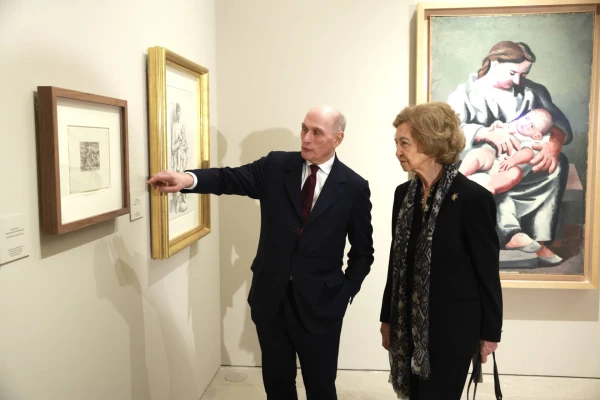
He said the Bible was for Picasso a “profound structure” of his sensibility, “an inner interpretive key forged in the sensory experience of the liturgy and the sacred Catholic imagery of his childhood.”
He emphasized that in many of Picasso’s works, “the body of Christ becomes an archetype of human suffering,” particularly visible in the painting “Guernica,” “where the rhetoric of sacred iconography emerges as a language of pain.”
For the cardinal, this exhibition also constitutes “an exemplary act of cultural dialogue: The cathedral and Picasso are not viewed as separate entities, but rather they challenge and illuminate each other by addressing the ultimate questions about meaning, suffering, and fraternity.”
On behalf of Pope Leo XIV, he encouraged continued promotion of an authentic dialogue between Christianity and contemporary culture, “convinced that the artistic experience demands taking a broad view capable of recognizing the spiritual depth that dwells even in those who do not profess to be believers.”
The opening of the exhibition — organized by the Archdiocese of Burgos, the Metropolitan Chapter, the FABA Foundation, and the Burgos Consulate of the Sea Foundation — was also attended by the vicar general of the archdiocese, Father Carlos Izquierdo Yusta, and Archbishop Emeritus Fidel Herráez Vegas, as well as other local officials.
For Archbishop Mario Iceta of Burgos, the exhibition “constitutes a new milestone in the cathedral’s historical dialogue with culture.”
He also recalled that the Burgos Cathedral, since the laying of its foundation stone by King St. Ferdinand (1199–1252), “has integrated all artistic styles throughout the centuries like a living organism,” and that today it also seeks to open itself up to contemporary culture through the work Picasso, a “leading and highly influential” artist.
The artist’s grandson emphasized that the exhibition also has a profound meaning for the Ruiz-Picasso family, since “the artist visited the church ‘incognito’ in 1936, accompanied by his wife and son,” in what would be his last visit to Spain.
This story was first published by ACI Prensa, the Spanish-language sister service of EWTN News. It has been translated and adapted by EWTN News English.